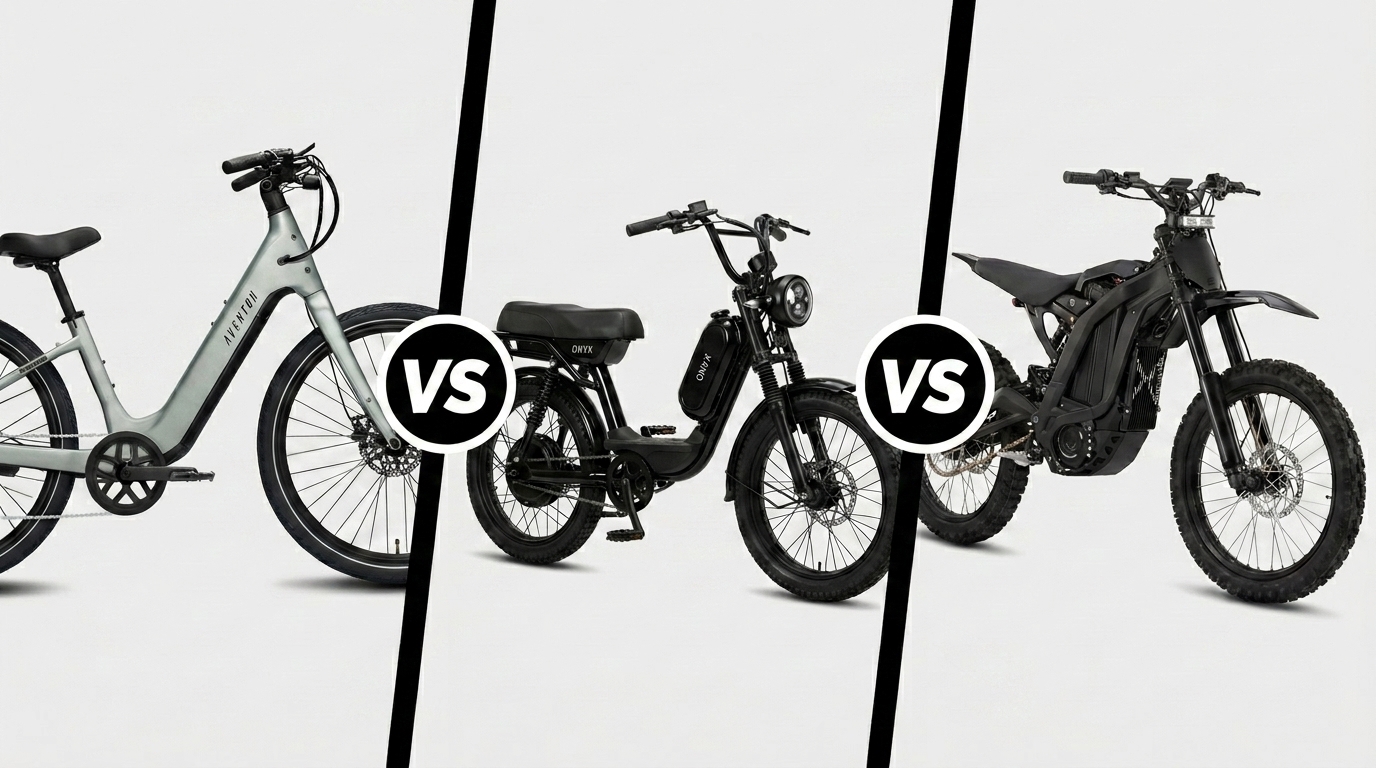
Guide to E-Bike Classes
E-bike Classes Explained and the Difference Between e-Bikes, Mopeds, and Motorcycles.
E-bikes have exploded in popularity. If you are shopping for an e-bike, you've likely seen them categorized into "Classes," but the reality of how these bikes operate often blur the lines of the law.
This guide explains e-bike classes, the history behind them, and the critical differences between an e-bike, a moped, and a motorcycle.
1. The Strict Legal Definition
When the legal three-class system was originally drafted by industry advocacy groups like PeopleForBikes, the categories were designed to be distinct and strictly regulated:
- Class 1: Pedal-assist only, with motor assistance stopping at 20 mph.
- Class 2: Throttle-assisted, with motor assistance stopping at 20 mph.
- Class 3: Pedal-assist only, with motor assistance stopping at 28 mph (also requires a functional speedometer).
Under a strict interpretation of this law, if a bike has a throttle, it cannot be a Class 3 e-bike.
2. Stacked Class Programming
Despite the strict legal definitions, e-bike manufacturers quickly noticed a trend: buyers heavily favor having a throttle, and they also like to go faster than the 20 mph top speed of a Class 2 bike. To bypass the strict legal definitions, brands engineered a clever compromise known as "stacked" or dual-class programming.
Here is how it works:
- The 20 mph Throttle Cutoff: Most "Class 3" bikes you see for sale today will accelerate up to 20 mph using the throttle alone, effectively acting as a Class 2 e-bike.
- The 28 mph Pedal Assist: To get from 21 mph to 28 mph, the throttle completely shuts off. You must actively pedal to unlock that extra power, allowing the bike to act as a Class 3.
Because the throttle itself never propels the bike past 20 mph, manufacturers argue that the bike complies with the safety spirit of the law.
Direct-to-Consumer (DTC) Custom Settings
The discrepancy between internet information and retail reality often comes down to software. Many modern e-bikes from direct-to-consumer brands like Aventon, Lectric, or Velotric ship out of the box restricted to Class 2 limits (20 mph with a throttle).
However, they explicitly feature a "secret" menu in their digital display or smartphone app that allows the user to unlock Class 3 speeds (28 mph). When unlocked, the throttle remains active up to 20 mph. This workaround leaves these bikes in a legal gray area that most local police do not have the time or training to enforce.
Changing State Laws
Because of this widespread manufacturer workaround, states have started stepping in to fix the ambiguity. For example, California recently passed SB 1271, explicitly codifying that Class 3 e-bikes are strictly banned from having throttles (allowing only a tiny 3.7 mph "walk-assist" mode). If you buy a new Class 3 e-bike in California today, the manufacturer must program the software to completely disable the throttle.
3. History of the 3-Class System
The original designers of the three-class system left the throttle off Class 3 bikes for one main reason: to protect bicycle access on public infrastructure.
When they drafted the model legislation in the 2010s, they had to convince skeptical lawmakers, park rangers, and traditional cyclists that e-bikes belonged on bike paths and shouldn't be regulated like motor vehicles. Leaving the throttle off high-speed e-bikes served several strategic purposes:
Pleasing the DMV and Federal Lawmakers
To keep e-bikes from being regulated as mopeds or motorcycles, designers had to align with consumer safety laws. Under U.S. federal law, a "low-speed electric bicycle" is defined as having a top speed of 20 mph under motor power alone. A Class 2 bike with a throttle fits this definition perfectly.
However, a bike that can throttle up to 28 mph completely violates federal consumer definitions. It legally crosses the line into a motor vehicle, which would require a driver's license, registration, and a VIN number.
Active Engagement
To get e-bikes allowed on traditional bike infrastructure, advocates had to prove that e-bikes were still inherently bicycles, not electric dirt bikes. By requiring human pedaling to reach 28 mph, the law ensured the rider was physically engaged in operating the vehicle. Lawmakers were comfortable with 28 mph only if the rider had to earn it through pedaling. They feared that a 28 mph throttle would allow completely passive, untrained riders to fly down bike paths effortlessly.
Safety and Speed Management
A bike traveling at 28 mph carries significantly more kinetic energy than one traveling at 20 mph. Designers worried that if a rider could "whiskey-throttle" (accidentally twisting the grip full-open) straight to nearly 30 mph from a dead stop, it would cause severe accidents in crowded pedestrian areas or bike lanes. Forcing the rider to pedal acted as a natural safety buffer to modulate that high speed.
Emulating the Successful European Model
Europe has a highly successful, deeply entrenched e-bike culture that relies heavily on "Pedelecs" (pedal-assist only). In Europe, throttles are essentially illegal on e-bikes. Major global bike manufacturers like Trek, Specialized, and Giant already had massive supply chains built around European pedal-assist mid-drive motors (like Bosch or Shimano). U.S. advocates copied the European Class 1 and Class 3 structures to make it easy for these established brands to sell their existing, throttle-free inventory in America.
How the Compromise Won: The designers thought they were creating strict, isolated buckets, but didn't anticipate the rise of DTC hub-motor brands, who realized they could give consumers the best of both worlds by combining a Class 2 throttle with Class 3 pedal-assist.
4. Why 20 mph and 28 mph thresholds?
- Why 20 mph? This is the average speed of an experienced, unassisted cyclist on a traditional road bike. Federal regulators determined that keeping electric motors capped at 20 mph meant e-bikes would share the same kinetic energy footprint as standard bicycles, posing no extra threat to pedestrians or traditional cyclists on shared paths.
- Why 28 mph? The 28 mph cap is a direct American adoption of European "S-Pedelec" (Speed Pedelec) laws. In Europe, standard e-bikes are capped at 25 km/h (15.5 mph), but a higher tier for commuters allows riders to go up to 45 km/h. 45 km/h = 27.96 mph. U.S. advocates rounded this up to 28 mph so global manufacturers wouldn't have to redesign their motors specifically for the American market.
5. Power Limits and the Nominal Loophole
In the United States, the three-class system dictates that all legal e-bikes must have a motor with a power rating of 750 watts or less. If a motor exceeds 750 watts, the vehicle legally exits the e-bike classification entirely.
However, a major technical loophole exists: the laws specify a nominal rating of 750W.
- Nominal Power is the wattage a motor can handle safely and continuously for long periods without overheating.
- Peak Power is the brief burst of energy a motor can draw when accelerating from a dead stop or climbing a steep hill.
Because the classes specify a nominal 750W cap, many legal Class 2 or Class 3 e-bikes on the market actually feature a "750W motor" that pulls 1,200W to 1,500W of peak power in short bursts, delivering far more torque than lawmakers originally envisioned.
6. When Does an E-Bike Become a Moped or Motorcycle?
The risk of catastrophic injury scales exponentially, not linearly, with speed. A bike crashing at 28 mph carries roughly twice the destructive kinetic energy of a bike crashing at 20 mph. Standard bicycle components (spokes, rims, bicycle-grade rim or disc brakes) are simply not engineered to safely dissipate the forces generated at 30+ mph. Vehicles going over 28 mph require heavier frames, motorcycle-grade suspension, and larger hydraulic brake rotors to stop safely, pushing them structurally away from bicycles and into motor vehicles.
Any vehicle exceeding Class 3 limits (28 mph with pedal assist) or the 750-watt nominal motor limit crosses from a bicycle into a full motorized vehicle:
- Mopeds: These typically feature motors up to 50cc (gas powered) or 750-1500 watts, with top speeds capped between 20 mph and 30 mph. They do not require shifting gears but often mandate a regular driver's license, vehicle registration, and a helmet.
- Motorcycles (Class M): If the vehicle exceeds 30 mph or has a motor larger than 50cc or 1500W, it is legally classified as a motorcycle. Operating these requires a specific motorcycle license, registration, insurance, and compliance with all traffic laws (in some areas these laws do not apply when on private property).
- Class 4 E-Bikes: In many states, any e-bike with a motor over 750 watts or an unlimited top speed that isn't capped falls into a catch-all "Class 4" category, which carries the exact same legal rules as mopeds or motorcycles.
Summary Checklist for Buyers
- If the throttle cuts off at 20 mph but you can pedal to 28 mph: It is an out-of-the-box hybrid Class 2/3.
- If the throttle can push you all the way to 28 mph without pedaling: It is not legally an e-bike in most states; it is legally a moped.
Browse our comprehensive database and compare hundreds of e-bikes, e-mopeds, and e-motorcycles to find the perfect ride for you!